


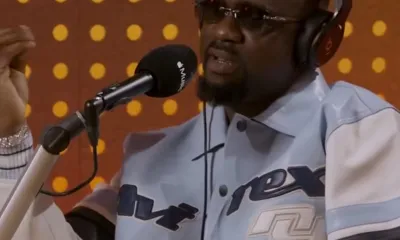
Rapper Sarkodie has said Ghanaian musicians face difficulties securing substantial financial backing from wealthy individuals, unlike their Nigerian counterparts, whose businesspeople are more willing to invest in the entertainment industry.
The rapper said some wealthy Ghanaians support artistes they know personally, but the scale of investment needed to compete internationally remains a challenge.
Speaking to Serwaa Amihere on her When We Sit platform, Sarkodie described how a Nigerian businessman he met in London spoke openly about investing in an artiste because he believed the musician could help promote Nigeria.
He said the businessman explained that supporting the artiste was not merely an act of generosity but also an investment in his country’s image and, indirectly, his own business interests.
“He was talking about the fact that he supported the money he mentioned, and it’s normal. He said, like, ‘I’m trying to flex.’ I just had to support him with this because I think he has the talent,” Sarkodie recounted.
He said what stood out to him was the businessman’s belief that the artiste could help advance Nigeria’s interests.
“You see, his emphasis was he can take Nigeria, because through that, his business it also helps his business,” Sarkodie said.
Asked whether Ghana had wealthy individuals providing similar support, the rapper acknowledged that some people contribute, including friends who help fund his Rapperholic concerts. However, he said such assistance does not eliminate the financial burden on artistes.
“There have been friends. I have friends who, even in Rapperholic, they can chip in bread to support,” he said.
Sarkodie explained that organising major concerts requires substantial spending, and artistes sometimes take losses simply to maintain their brands.
“Rapperholic, for the first couple of years, we didn’t make a… we sometimes take losses, and it’s more about just keeping the brand going,” he said.
He added that many people underestimate the cost of staging large-scale shows, including the expenses involved in mounting international productions.
“If I break down what it takes to do the O2, you would freak out,” he said.
Sarkodie also described an incident at a UK event where a Nigerian businessman reportedly paid for a full 24-hour venue booking even though the artistes needed only a few additional hours to perform.
The rapper said the businessman was prepared to absorb the extra cost to ensure the performers could finish their sets.
He argued that such a willingness to take financial risks for local talent was an important difference in the way some Nigerian investors approach entertainment.
Sarkodie said he prefers presenting potential backers with business proposals explaining how their money could generate returns, rather than simply asking them for free support.
“Me, I hate taking money for free, and all my friends will tell you, even my rich friends, I will not tell you, ‘Oh, support.’ I give you a business plan. When you put this amount of money, you make this out of it,” he said.
Despite that approach, he said it remained difficult to convince people to invest, even as some continued to question why Ghanaian artistes were not doing more internationally.
Sarkodie concluded that Ghana needed a stronger culture of investment in its creative industry if local artistes were expected to compete at the highest level.
“Until we put our money where our mouth is, let’s stop the complaints and let’s enjoy the ride,” he said.